 Click here to hear the call of this species (141 KB MP3 file)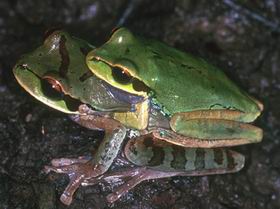
Click here to hear the call of this species (141 KB MP3 file)
Family: Hylidae
Common names: Blue-spotted Treefrog
1) Distinguishing features
Size (SVL) Males 50 - 56mm, females 60 - 70mm
Dorsal colour may be leaf green, pale green, tan or gold depending on time of day and temperature. Dark brown or green dorsal markings are present, including markings on the occipital and interorbital regions. The thigh or shank has three or four dark brown or green transverse bands. The margin of the upper lip is creamy white, a dark brown canthal stripe extending from the nostril to the eye and a dark brown postocular mark from the eye to the axillary region, including the tympanum. A gold or bronze stripe runs from the snout above the dark canthal stripe across the lateral edge of the eyelid and above the dark postocular markings onto the flank. The flanks and anterior and posterior surfaces of the thighs are dark brown to reddish brown with many small pale blue spots. The webbing is brown, the venter creamy white and the iris copper coloured. The snout is broadly rounded in dorsal profile, the forelimbs relatively long and robust, and the dorsal skin smooth. Digital discs are relatively small, the fingers about one third webbed and the toes about three quarters webbed, and a thin, well developed tarsal fold extends the length of the tarsus.
2) Distribution
50 to 750m elevation. Known in the Evergreen Broadleaf Forest and Subtropical Evergreen Forest formations, but actual distribution in Belize poorly documented.
3) Natural history
Reproduction dependant on rains and maybe active throughout most of year during wet periods. Eggs have been found in temporary ponds, in water filled depressions in logs, forks of tree trunks and in springs and quiet stream pools, deposited as thin surface film. Appears to occur high in forest, probably inhabiting arboreal bromeliads and trees at low to medium heights. Call is one or two short notes, "wonk, wonk".