 Click here to hear the call of this species (141 KB MP3 file)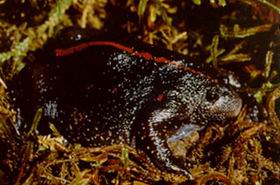
Click here to hear the call of this species (141 KB MP3 file)
Family: Rhinophrynidae
Common names: Mexican Burrowing Frog / Middle American Burrowing Toad
1) Distinguishing features
Size (SVL) Males 65 - 75mm, females 70 - 80mm
Dorsum is blackish or dark grey, usually with reddish orange markings. These markings may well be yellowish in some individuals. Middorsal stripe and mottling on the dorsolateral and upper lateral surface of the flanks is usually present. The venter is uniformally grey or blue-grey. Dorsal skin is smooth, but with a few minute, scattered tubercles. It is a globular anuran with an especially fat body, a small tapered head and tiny eyes, and the tip of the snout is flattened and appears calloused. Digits lack discs, and the toes are about three quarters webbed. The hind foot has only four digits and there is no tarsal fold, instead, along the inner tarsal surface are two large whitish, spadelike tubercles used for digging.
2) Distribution
Found at lower elevations throughout Belize where soil conditions allow this fossorial species to burrow. Seems primarily to inhabit open or disturbed situations in the wetter parts of its range, and elsewhere restricted to seasonal forests with a noticeable dry season.
3) Natural history
These frogs are accomplished burrowers, and only appear above ground after the heaviest rains of the year. Breeding occurs during the rainy season only. They aggregate around temporary ponds and aguadas that the heavy rains fill. Males greatly inflate their bodies when calling, and eggs are laid singly and sink to the bottom where they later coalesce to form large clutches. Tadpoles school, and many thousands of tadpoles may metamorphose into froglets and leave the water at the same time, and head for the nearest muddy banks or other cover where they burrow into the ground.
4) Remarks
This species is perhaps the most ridiculous looking animal one is likely to ever see, an excellent example of the marvels of the natural world.