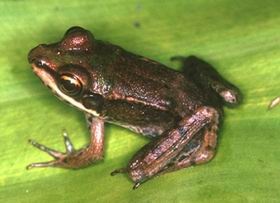
Family: Ranidae
Common names: Julian's Frog / Maya Mountains Frog
1) Distinguishing features
Size (SVL) Males reach about 70mm, females up to 100mm
The dorsum between the dorso-lateral folds is medium brown, often with scattered dark blotches. The sides of the body beneath the well developed dorso-lateral folds are uniformly dark brown and the venter is cream. The frog possesses a cream supralabial (upper lip) stripe and a distinct black face mask. The ear is pale brown and of similar diameter to the eye. The skin of the dorsal surfaces is denticulate (common amongst ranids), and the sides of the body (below the dorso-lateral folds) are covered with raised striations. Webbing between the toes is extensive if not complete and the toes are not expanded to form discs. As is typical in many stream dwelling species vocal slits and sacs are absent in males.
2) Distribution
This species is considered to be an endemic of the Mayan Mountains of Belize, known from Mountain Pine Ridge and Little Quartz Ridge of Toledo district and also reported in mountains of the Cayo district. Elevations between 1000 and 3000ft.
3) Natural History
Occurs commonly in streams of Mountain Pine Ridge and also known from Subtropical Evergreen formations. There appears to a be a clear ecological restriction to the riparian habitats around mountain streams. No vocalisations are known are there are unlikely to be any owing to the absence of vocal slits or sacs. Eggs are presumed to be laid in streams and it is likely that breeding takes place in the rainy season.
4) A new species ?
During Project Anuran Phase I, an individual was caught which closely resembled Rana juliani, but which also differed in several key features. Although the specimen possessed the bold markings on the posterior thigh and the distinct supr-labrial stripe characteristic of R. juliani, its tympanum was relatively tiny - about 1/3rd the diameter of the eye. Another species R. maculata is noted to occur in the Peten region of Guatemala, which serves to match this description although there are no known records from Belize. Professor Julian Lee, the herpetologist after whom R. juliani takes its name, suggests that it may be an unusual morph of either R. juliani or R. vaillanti, which is particularly likely with respect to its juvenile condition.