 Click here to hear the call of this species (156 KB MP3 file)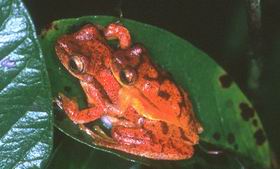
Click here to hear the call of this species (156 KB MP3 file)
Family: Hylidae
Common names: Yellow (Cricket) Treefrog / Small-headed Treefrog
1) Distinguishing features
Size (SVL) Adult males up to 25mm, females up to 30mm
Dorsum is yellowish or tan broken by irregular dark spots, and reticulations with X or H shaped markings. A dark interorbital marking is usual as are narrow, lateral dark lines (pale bordered above) extending from above the eyes to the sacral region. Thighs uniformly yellow and the shanks have dark transverse markings. The venter is mostly whitish. The iris is bronze. Snout somewhat pointed in dorsal profile, and the skin on the dorsum is smooth. Forelimbs are short and moderately robust and an abbreviated axillary membrane is present. Fingers about one third webbed, the toes about three quarters. A poorly defined tarsal fold extends the length of the tarsus.
2) Distribution
Sea level to 750m (at least 333m in Belize). Known from most vegetation formations, except for the Subtropical Evergreen Forest and Elfin Forest. Appears most abundant in open or disturbed areas, shying away from the deep forest.
3) Natural history
Nocturnal and largely arboreal. Breeding coincides with much of the rainy season, but may also take advantage of heavy rains at other times. Males call from low emergent bushes and grass in ponds. Often breeds in large choruses with thousands of individuals calling. Eggs deposited in small clumps on vegetation just beneath the water surface. Generally encountered around standing water, ranging from temporary ditches and pools to permanent lagoons. Call is a cricketlike sound "shreek, shreek, shreek" repeated at frequent intervals.