 Click here to hear the call of this species (266 KB MP3 file)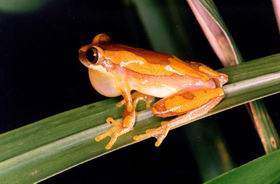
Click here to hear the call of this species (266 KB MP3 file)
Family: Hylidae
Common names: Hourglass Treefrog / Variegated Treefrog
1) Distinguishing features
Size (SVL) Males 24 - 27mm, females 30 - 34mm
Dorsum is yellow or yellowish tan, and maybe uniformly covered, although almost all have brown dorsal markings. These are highly variable in shape, but often take the form of an hourglass. The side of the head is mostly brown, with distinct cream upper labial stripe which usually is expanded to a pale spot below the eye. Thighs uniformly pale orange or yellow, the upper arm, flanks, hands and feet pale yellow. Venter is cream and iris is reddish bronze. The snout is truncate in profile. An extensive axillary membrane extends almost to the elbow, the discs on the digits are relatively large, and the toes about three quarters webbed, fingers about one half webbed. Patternless individuals distinguished from H. loquax by the orange-red colouration of the webbing and posterior thighs in the latter species. A thin tarsal fold extends the length of the tarsus.
2) Distribution
Sea-level to 600m. Appears to be restricted to the Semi-evergreen Seasonal Forest and possibly the drier portions of the Evergreen Broadleaf Forest formations.
3) Natural history
Nocturnal, arboreal frogs. Presumably spending most of non-breeding time up in forest trees, possibly in bromeliads. During rainy season call from low emergent vegetation at the edge of a pond, from dusk throughout most of the night. Eggs laid in clumps comtaining 24 - 76 eggs in a single layer on the upper surfaces of leaves above water. Call is a high-pitched squark or creeek, repeated at frequent intervals - easily confused with H.microcephala to the untrained ear.
4) Remarks
Although common in the north and central Belize, has yet to be found in the wetter south. Future studies needed.