Family: Centrolenidae
Common names: Northern Glassfrog / Mexican Glassfrog / Fleischmann's Glassfrog
1) Distinguishing features
Size (SVL) 22-25mm (males slightly smaller)
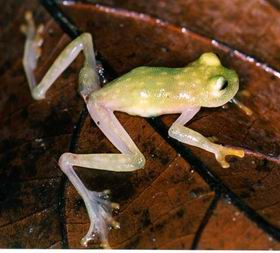
Dorsum is smooth in texture and a pale, lime green with many tiny scattered dark melanophores and small yellow spots. Top of digits and discs art yellow. Name derives from the characteristic transparent venter, through which some organs can be seen - especially the heart. The iris is gold. The snout is exceptionally short in dorsal profile. Digits have well developed discs that are moderately expanded to form discs. Fingers are about ½ webbed (toes ¾). Tarsal fold is absent. Vocal slits are present and the vocal sac is moderately distensible. Tadpoles are mostly transparent with tiny uniformly serrated beaks.
2) Distribution
Occurs widely in the wet forests of Central America up to 1,600m. Known in Belize in Cayo, Belize and Toledo and Stann Creek districts.
3) Natural History
Found in Evergreen Broadleaf and Subtropical Evergreen Forest formations. In Mountain Pine Ridge they are confined to broadleaf forests that border streams though the pine forests. Occurring near free-flowing, clear streams (especially during breeding)- quite common if habitat is suitable, although this is limited in the Yucatan peninsula. Possibly also inhabit epiphytes in more humid situations. Almost exclusively nocturnal in activity. Most males vocalise from undersides of vegetation overhanging water. The call is a high pitched peep of about 0.1 seconds repeated every 6-16 seconds - this is usually heard from a chorus of males. Males are highly territorial - an intruder elicits a series of more mew like peeps and even physical grappling can ensue. Eggs are deposited on the underside of leaves (ie heliconias) and are guarded by the male (between 18-30 in one brood). Eggs hatch and tadpole fall into streams below. Growth and development of tadpoles is slow with metamorphosis possibly taking up to a year.
4) Remarks
The glassfrogs reach their greatest diversity in the South American Andes. This is the only species to occur in Belize. Until recently this frog (and 23 others) was put in the genus Centrolenella which is known considered to be a synonym of Hyalinobatrachium.