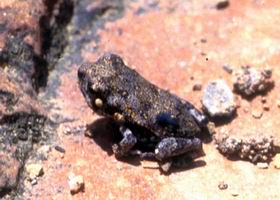
Family: Leptodactylidae
Common names: Sanderson's Streamfrog / River Rainfrog
1) Distinguishing features
Size : Possibly the largest member of its genus in Belize, adult male 35-50mm, adult female 70-85mm (SVL).
Dorsum is brown, gray-brown to olive with irregular dark markings often with distinct orange or rust spots in the interorbital region or on the back, although a uniform dorsal colour is not unknown. In keeping with species of the rugulosus group the skin is moderately tuberculate, often with large tubercles on the flanks and eyelids. No mid-dorsal stripe is present in any known species. Dark markings/bands are present along the lips often with a black interorbital bar. Dark head and limb markings are variable. The posterior thighs are dark brown or gray-brown with a mottled cream pattern. The belly is white or purplish and the throat is heavily mottled with brown or grey brown. The iris is gold to copper with fine, dark reticulations but no division as in E. sabrinus. Tympanum is distinct (roughly 2/3rd eye diameter in males and 2/5th in females). Compared to other members of the genus the toes bear characteristically significant webbing - roughly one quarter to one third, and the tips of toe and fingers are reasonably expanded to form discs. Strongly developed inner tarsal fold which extends half-way to two-thirds the distance from the inner metatarsal tubercle to the heel. Vocal slits are absent on the males, but a whitish nuptial pads are present on the pollex of adult males (cf: E. rugulosus).
2) Distribution
Known only in the Caribbean slopes of the Maya Mountains of Belize and the Caribbean foothills of Guatemala - sea level to 700m.
3) Natural History
Occurs in the tropical wet forest and subtropical wet and moist forest seemingly restricted to certain streambeds. It appears to be strictly nocturnal being found on the face of ledges and behind water falling over frogs. Very little is known of its biology but the eggs appear to undergo direct development during the wet season not dissimilar to other members of the genus.
4) Remarks
This species is closely related to other members of the E.rugulosus group including E. sabrinus, and E.rugulosus. Following Campbell & Savage (2000) these three species are recognised as distinct. In the vicinity of Las Cuevas it is most likely to be confused with E. sabrinus, from which it is most easily distinguished by the extent of webbing on hind feet of E.sandersoni, significantly different length of hind limbs (E. sabrinus being greater), presence of vocal slits in adult male E. sabrinus, and the presence of nuptial pads in adult male E.sandersoni.