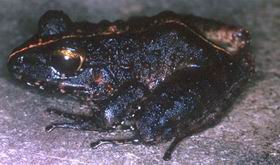
Family: Leptodactylidae
Common names: Long-legged stream frog
1) Distinguishing features
This is a medium sized frog in its genus - adult males roughly 30-41mm, adult females 60-75mm (SVL).
Dorsum is pale to dark brown with dark brown or black mottling and often a pale and thin mid-dorsal line or broad stripe. An interorbital bar is present, its posterior border usually black, and there are dark markings along the lips and three to four dark transverse limb bars, although these markings are highly variable. The posterior surface of the thighs is dark brown with large, pale spots. The whitish venter is suffused with brown pigment and the throat is mottled in males and females. Iris is gold above and dark brown below. The dorsum is finely granular with large tubercles on the flanks. Digits are well developed and moderately expanded and toes have a moderate degree of webbing - less than ¼ (c.f. E. sandersoni). The inner tarsal fold is strongly developed and extends about half way from the inner metatarsal tubercle to the heel. Adult males have vocal slits but no nuptial excrescences.
2) Distribution
Occurs in the Atlantic foothills of northern Central America including the Maya Mountains of Belize from near sea level to about 600m.
3) Natural History
This frog is almost always encountered near streams running though pristine tropical wet and subtropical wet and moist forests (sympatric with E. sandersoni). Eggs undergo direct development and the nests are found well camouflaged in dirt near to stream banks. For distinction from the commonly confused E. sandersoni see the separate entry for this species.
4) Remarks
The Eleuterodactylus rugulosus group has recently undergone an extensive taxonomic revision (see Campbell & Savage 2000), and E. sabrinus was one of ten new species to be described. The name sabrinus is taken from the Latin sabrina which means river-nymph.