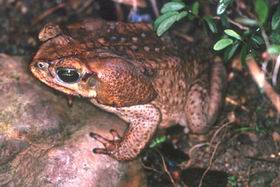
Family: Bufonidae
Common names: Giant toad / Marine toad / Cane toad
1) Distinguishing features
Size (SVL) 200mm plus - largest toad in Belize.
Females reach larger sizes than males. Males reddish brown with spiny tubercles covering dorsum. Females medium brown to pale gray-brown, darker brown mottling (similar to juveniles), large rounded tubercles. Prominent cranial crests (canthal, supraorbital, postocular and supratympanic). Huge, enlarged parotoid glands (distinguishable from all other toads) - occupy area larger than side of head and extending posteriorly to a level well beyond insertion of forearm - coloured similar to dorsum or sometimes reddish brown. Snout pointed in dorsal view. Skin on dorsum rugose - numerous large tubercles. Limbs moderately short and stout. Males have keratinized patch on thumb.
2) Distribution
Common at lower elevations throughout Belize. Primarily found in open habitats such as savannas and secondary forests; it is uncommon in or completely absent from closed-canopy forests. Seldom found far from water. Has become a human commensal over much of its range, and it is now very abundant in and around human habitations. Throughout the Yucatan Peninsula these toads congregate beneath streetlights and feed on the insects attracted to the lights. They are often seen on roads at night, especially following rains, and can easily be mistaken for small boulders.
3) Natural History
Nocturnal - tropical dry, moist and wet forest and subtropical dry and moist forest. Eats almost anything that moves and can be swallowed !. Usually extremely abundant where ever it occurs - well protected by toxic secretions from its parotoid glands - it is not a good idea to handle this species. Year round breeder, especially around permanent water where eggs laid in stings - breeding peek coincides with beginning of rainy season. Loud, rolling thrill like call, very distinctive.