 Click here to hear the call of this species (166 KB MP3 file)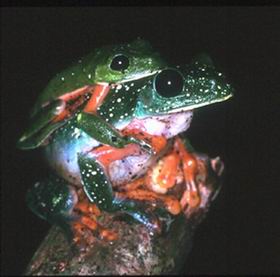
Click here to hear the call of this species (166 KB MP3 file)
Family: Hylidae
Common names: Morelet's Leaf-frog / Morelet's Tree-frog
1) Distinguishing features
Size (SVL) Adult males 60-65mm, adult females 75-80mm
The dorsal surfaces of head, body forearm and hindlimbs are green as for A. callidryas - white spots may also be present on the dorsal surface. Again similar to A. callidryas the flanks, anterior and posterior surfaces of the thighs, inner surfaces of shanks and forearms, upper arms and three first fingers and first four toes are orange. White stripes are present on the outer edges of the forearm and tarsus. The venter is cream or yellow. In marked comparison to A.callidryas there are no barred blue markings on the flanks and the iris is deep purple/black rather than bright red. The eyelid remains reticulated with gold. The skin of the dorsum is smooth in texture. As in other members of the genus the legs are long and slender and this species tends to walk rather than leap. Digits bear well expanded discs and the webbing on the hands and feet is about ¾. The tarsal fold is usually well developed and extends the length of the tarsus. Vocal slits are present and the vocal sac is not greatly distensible.
2) National distribution
In Belize it is known only from 1500-2000ft in the Mayan Mountains. It may occur higher if breeding sites are available. Suggested to be more common than presently thought in understudied areas of the Mayan Mountains.
3) Natural History
This species appears to replace A.callidryas at higher elevations in Belize and appears to be restricted to Evergreen Broadleaf Forest and Subtropical Evergreen Forest. It is an uncommon species and probably inhabits epiphytes, and branches of trees and has been found in Cayo and Toledo districts of Belize. The breeding call is a 'wor-or-op' repeated every one to several minutes. Eggs are similar to those of A. callidryas in being green at one pole and cream at the other and usually laid on vegetation overhanging permanent or temporary pools. The egg mass is usually twice that of A. callidryas. There is an extended breeding season from May to August