 Click here to hear the call of this species (134 KB MP3 file)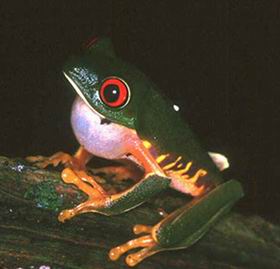
Click here to hear the call of this species (134 KB MP3 file)
Family : Hylidae
Common names : Red-eyed Leaf-frog / Red-eyed Treefrog
Size (SVL) Adult males 50-55mm, adult females 65-70mm
As the name suggests this frog is characterised by having a bright red iris. The eyelid is reticulated with gold. The dorsum surfaces of head, body, forearm, hind limbs, fourth fingers and fifth toes are green, often with white spots. The flanks are bluish with 3-8 vertical cream bars, the venter is cream. The anterior and posterior surfaces of the thighs and the hands and feet are mostly orange. The skin of the dorsum is smooth in texture. The frogs have long slender limbs and tend to walk rather than leap. Digits bear moderately large disks and fingers are one-half and toes about two-thirds webbed. A poorly defined tarsal fold is present. Along with A.moreletii it is the only frog in the Petan to have a vertical pupil. Vocal slits are present and the vocal sac is not greatly distensible.
2) National distribution
This frog occurs country wide at elevations between sea level and about 600m
3) Natural History
This frog is common in wet forest habitats (Semi-Evergreen Seasonal & Evergreen Broadleaf but perhaps Subtropical Evergreen), especially in the wet season around pools, aguadas, slow moving streams and water filled ditches. They are nocturnal and search for insects through the vegetation with slow, graceful movements. Calling generally begins about dusk and the call of the male is a single or double 'chuck' or 'cluck'. Males will call from vegetation surrounding ponds between 1-5m in height. Calling individuals can congregate into a chorus of over a few hundred individuals. Eggs found around pools on overhanging vegetation and are greenish at one pole and cream at the other. Following hatching the tadpoles fall into the water with development taking roughly 2 months. The breeding season is extended and lasts over the wet season.