On top of the world
A family holiday to northern Norway...
I walked to the edge of the cliff, leaned against the cold metal railings, and shaded my eyes from the glare of the setting sun. Spread out ahead was the vast, flat plain of the Arctic Ocean, illuminated in evening shades of dusky blue. A thousand feet below me, a cruise ship drifted past like a plastic boat in a paddling pool, dwarfed by the titanic tower of rock on which I was standing. Ahead, to the north, the sun was sinking towards the water. Its crimson rays glinted and flashed on the windows of the hundreds of cars and caravans lined up on the rocky plateau behind me. Every vehicle at this unearthly gathering was pointed towards the cliff edge, its occupants staring out to sea, as if this sunset was the last that they would ever see.
As the minutes passed, the sun began to fall faster until its lowermost fringes finally made contact with the waters below. As the inexorable forces of nature slowly squeezed the blazing ball against the horizon, it burst, squirting streams of fire to either side. The sky was a rainbow, graduating slowly from the reds and yellows of the sunset to the celestial blue overhead. Behind me, completing the rainbow, rows of barren mountains stood outlined in faint shades of pastel pink and purple. Eventually, the sun lost its battle with nature, and sank silently beneath the rolling waters.
For the last eleven days, my family and I had journeyed northwards through Europe, and now, three hundred miles north of the Arctic Circle, we could go no further. We had reached the North Cape of Norway, the uppermost extremity of the continent, and ahead there was now nothing, except for a few frozen islands, between us and our planet's pole. We were at the climax of a trip that would last nearly a month, cover six thousand miles, and take us past some of the greatest natural wonders that Europe has to offer.
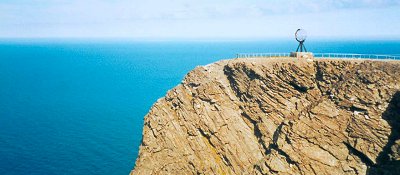
Norway's North Cape, the topmost point of Europe, juts out into the Arctic Ocean
Our journey began on a sunny summer's day in our bustling home village of Emberton, a place that seemed a million miles away from the silent splendour of North Cape. After a frenzied dash round the supermarket during which we stocked our hired camper van with everything we thought we would need for a month away, we had begun our journey, travelling first to Newcastle, from which an overnight ferry took us across the North Sea to the Norwegian port of Bergen.
Bergen, like many places in Norway, is a city of rock - cemented, like a cluster of concrete barnacles, to the barren mountains around. The harbour is a narrow affair, clinging tightly to the naked cliffs behind, in dramatic contrast to the ugly, sprawling ferry terminals of eastern England. The city looked grey and gloomy, under a typically overcast sky, and we had little inclination to explore the place. Instead, we headed inland, travelling north-east through the spectacularly mountainous terrain of western Norway. The scenery reminded me of Scotland, but on a much grander scale. The mountains were higher, the cliffs steeper, the rocky outcrops more jagged, the lakes larger, the forests greener, and each new landscape that flashed past my eyes seemed new and exciting.
I would happily have spent a whole summer exploring any of the secluded little places that we passed on that first afternoon, but as the camper-van sped along the fast Norwegian roads I barely had time even to look at them. The Norwegians have a uniquely ruthless attitude to road building, and out of the hundred and forty miles that we travelled on the first afternoon, about a third were underground. Some of the road tunnels that we passed through were short - just a few hundred metres - but in one we endured more than seven miles of blurred rocky walls and pulsing yellow lights before re-emerging into the clean white light of day.
It was not until the second day that we encountered an obstacle that had provided an insurmountable challenge to the Norwegian road engineers: Sognfjord, the wide grey stretch of water that splits central Norway in two. The fjord is a gloomy place, surrounded by looming black mountains, like the feet of great giants whose faces are lost in blankets of cloud. As we were ferried across, it was as if we had left the world of the living and were heading across the Styx and into the underworld beyond.
Beyond Sognfjord, the mountains became noticeably higher than before, and the road began to climb onto what guidebooks aptly describe as the 'roof of Norway'. Here, a mile above sea level, the landscape was desolate and icy, and the air felt noticeably thinner than in the valleys below. The road wound its way among gigantic slabs of snow, from which sprang streams of meltwater that trickled their way unimpeded across the bare landscape. Everywhere was rock - a garden of granite from which sprang only the toughest blades of yellowish grass. The dirty ice, dull rocks, and dreary sky gave the place a monochromatic feel - pale and devoid of colour.
Strange and wonderful though this landscape was, it was nonetheless a relief to finally descend back into the warmth and beauty of the valleys below, where sparkling rivers wound their way peacefully amidst coniferous forests that rolled away as far as the eye could see. For the next two days we headed north across this great green wilderness, bypassing the historic university town of Trondheim but stopping briefly in the village of Hell, which lived up to its unfortunate name when a local cash machine swallowed my father's credit card.
On the fourth day, we began to draw close to the dashed blue line on our map that had fixated us ever since we set out on our journey - the Arctic Circle. We stopped in a large tourist car park on the southern side of the Circle, and while my family attempted to extract various items of outdoor clothing from cramped lockers in the back of the camper-van, I walked on ahead, crossing the last few hundred metres alone, into the Arctic. The place was exactly as I had imagined. We had mysteriously left the lush pine forests a few miles behind, and now the landscape was barren and brown. A chilly wind blew across the moorland, and the low hills to the side lay smothered under a blanket of permanent ice.
I must have stood there, staring hypnotically northwards, for a full minute before I noticed the mosquitoes - large black beasts that whined around my face on all sides and brushed their legs and mouthparts expectantly against my soft skin. The landscape that had seemed so clean and open now buzzed and crawled with a million sooty legs and wings, and no matter how many times I succeeded in squashing one, there was always another waiting to take its place. At first the insects only added to the wild and rugged nature of the place, but after a while the mosquitoes became an irritation, and I was not annoyed to find that several of the creatures had somehow gained entry to our camper-van and were lurking motionless in the corners, ready to emerge at the most unexpected opportunity.
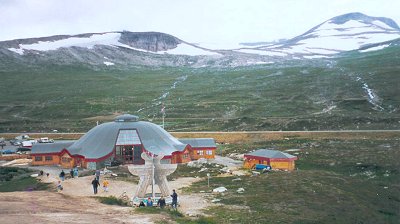
The Arctic Circle
The barren Arctic scenery was something of an illusion. The point at which we had crossed the Arctic Circle was, we began to realise, far above sea level, and as we continued north the road began to descend and the green forests returned. The horribly mosquito-filled moorland was left far behind.
After another two days of northwards travel, we reached the Lofoten Islands and the fishing port of Andenes - the only place in Europe where you are almost guaranteed the chance of seeing whales. At half past seven in the evening, we boarded a local whale-watching boat, consumed our free seasickness tablets, and headed off into the open Atlantic.
As the little houses of Andenes shrank into the coastal mist, we were treated to a glorious parade of local wildlife. Little flocks of puffins fluttered and skimmed across the rolling waves, gannets and fulmers wheeled and dived around the boat, and a lonely seal made its way ponderously past.
After an hour at sea, we sighted the distant plume of spray that signalled the distant presence of a great sperm whale. The boat turned and headed towards it, ploughing furiously through the rolling waves in the knowledge that the whale might at any moment dive and be lost from view. As we drew near to the geyser of breath, the boat turned off its engine, and I caught my first glimpse of the largest predator on Earth. This particular whale was, as we later learned from our guides, eighteen metres long, and at sixty tons it had ten times the bulk of Tyrannosaurus rex. Only the animal's weathered grey back showed above the water, but I could visualise the gigantic hulk below, drifting beneath the waves, watching us. After a minute or so the great creature dived; its back disappeared, and its enormous tail protruded above the water, as if waving us goodbye. Slowly, the giant flukes slid down into the water, and the leviathan disappeared beneath the ocean.
We experienced twelve such sightings before we turned around and headed back to shore. By now, an icy wind had begun to blow from the north, and the setting sun illuminated the cliffs ahead in a misty yellow light. This was one of the first short that the people of Andenes had seen for three months, and was a chilly reminder that the brief Arctic summer was coming to an end. As the tourists flocked south to warmer climates, the residents of this windswept coastline would soon be left to face the bitter polar winter, alone.
The next day we resumed our journey, past Tromsø, the world's most northerly city, and into the wilderness beyond. One morning, while my father filled the camper-van with petrol, I sat on the steps in a T-shirt and shorts, and felt hot in the morning sun. This could not be the Arctic. In the real Arctic, polar bears prowled across pristine ice floes in search of seal and walrus, and lemmings scuttled through snow-filled burrows as blizzards blew overhead. In this Arctic, crowds of German tourists wearing sun hats stood about in car parks studying road maps and swatting idly at biting insects with their leaflets and guidebooks. The Arctic of my imagination was a white wilderness. The landscape through which we now travelled was overwhelmingly green.
Not until we neared North Cape did the scenery begin to look truly polar. There were no forests here. A thousand icy winters had scoured the land of all but the simplest vegetation, leaving the place with the sterile appearance of another world. Not even ice clung to the jagged, windswept hillsides. My gaze met only the barren rock of a lunar landscape, as we covered the last few miles and looked ahead towards the rocky plateau where a cast iron globe and a grey visitor centre signalled the end of our northwards journey. We had reached the topmost point of Europe, and it was a desolate and unearthly place. This was more like the Arctic of my imagination.
This was originally written as a high school English essay